Menu•SiteMap |
History
The Champney Letter
– H. D'A. Champney
Events in Ealing
– E. H. Chater and others
THE CHAMPNEY LETTER
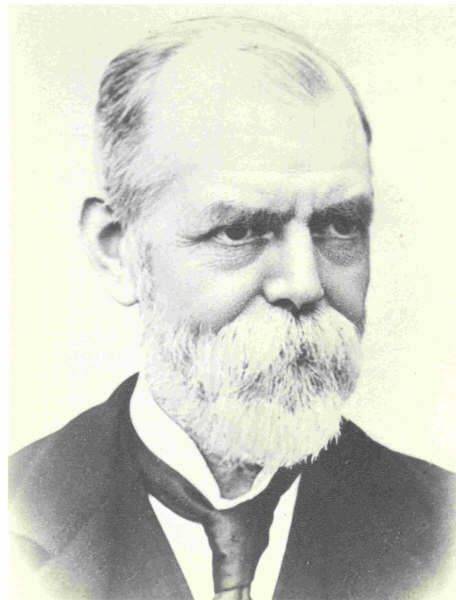
– H. D'Arcy Champney (1854-1942) |
|---|
| INTRODUCTION |
|---|
The text indicates that the letter was written in 1890
It was primarily written for the saints in France and Switzerland. |
|---|
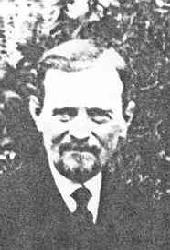
Those who are unfamilar with Mr. Champney should see a brief sketch in Biography: H. D'A. Champney.
- Mr. Champney was only 36 in 1890 when he wrote his 'Letter to the Saints', in which he skilfully chronicles the malicious and vicious opposition to Mr. Raven and the truth –
- and touchingly appeals to those in danger of being led astray by the partisan and divisive actions of some prominent persons.
His letter confirms my judgment that Mr. Raven is "without doubt, the most unfairly represented and unjustly maligned of any of the teachers among those known as brethren. His Letters disclose the mild and inoffensive spirit which marked him, even under the most severe
and unbrotherly attacks".
- The assumptions – for that is all they were – of FER's opposers only expose their ignorance as to eternal life and the Person of Christ –
- both of which have been further opened up and clarified in ministry by FER and JT.
- It is astonishing that brethren with the benefit of Mr. Darby's ministry, and with even average spiritual intelligence, could make such egregious blunders.
- Mr. Champney shows the Scriptural basis of FER's teaching and its agreement with JND's teaching.
Common Misconceptions of the TimesThe reader should be aware that some expressions are used which are common misconceptions – shared by the opposers then and still maintained by their successors. Three of these important matters – which have been clarified subsequently – are presented below. The reader may notice others. GAR
|
1. Our Lord's Sonship
FER himself later – Nov. 23, 1898 – wrote as to this matter:

Mr. James Taylor was fully aware of the above. When the matter arose, at Barnet in 1929, it was established there, as well as in later ministry and letters, that
- the expression "eternal" Son was not only unscriptural but it was derogatory to the Person of Christ.
- Letters of JT, 1: 260, 263; and Ministry by JT, 29: 361-74.
2. "The Beginning" in 1 John 1: 1-2
" 'That which was from the beginning' refers to the beginning of
Christ's service and ministry here", JT 68: 411.
" 'The eternal life, which was with the Father'; this life was with
the Father.
- "It does not refer to what was prior to incarnation, but what is
seen in the Lord on earth … The eternal life takes concrete form in the Son.
- "The expression here is not like John 1: 1: 'In the beginning was the Word' but 'That which was from the beginning', namely, eternal life. It is the thing he is dealing with, as taking perfect form in Christ …
- "It was life brought within the range of men, manifested in everyday circumstances", JT 68: 90-91.
3. "The Lord's Table"
The successors of the seceders still assert the preposterous and
pretentious claim to exclusive possession of the Lord's Table.
F.E.R. I think two things are very much confounded, namely, the Lord's supper and the Lord's table. He says, "This is my body which is given for you," Luke 22:19; that brings out His affection in giving Himself.
- The Lord's supper is remembrance, therefore I can understand that expression.
- The Lord's table is fellowship and responsibility.
- Up to chapter 11 (1 Corinthians) you have not come to any collective remembrance, and you come through chapter 10 to chapter 11, where you find the assembly come together.
From a reading, Ministry by JBS, 6: 271.
In spite of such misconceptions, Mr. Champney's work has a singular and
distinctive value
- not only as a significant historical document but as a poignant manifestation of genuine brotherly love and care.
- The length and the detail of the letter may be daunting to some readers – and will need more than one session to digest – but the concentration and effort it requires will be well repaid.
- To speed loading this file is in two parts.
The original edition made extensive use of italics and bold type which has been discontinued here as being distracting.
- Boxed notes with Mr. Champney's initials were footnotes in the original edition.
- Where possible, volume and page references have been added if not given by HD'AC. All references are to the 'Stow Hill' editions, unless indicated otherwise.
Events in Ealing is appended. It is a valuable supplement as an eye-witness account of the partisan spirit against FER.
G. A. R.
Page Top
LETTER TO THE SAINTS GATHERED TO THE NAME OF THE LORD JESUS CHRIST
– H. D'Arcy Champney |
|---|
"Commit thy way unto the Lord; trust also in Him; and He shall bring it to pass. And He shall bring forth thy righteousness as the light,
and thy judgment as the noonday", Psalm 37: 5-6.
"Said I not unto thee, that, if thou wouldest believe,
thou shouldest see the glory of God?", John 11: 40.
|
|---|
My Dear Brethren In Christ,
The following are some facts that should be known regarding the
sorrowful division which has occurred, a number of saints, led by Major
[H. H.] McCarthy, Mr. [W. J.] Lowe, Mr. Humphery, and others,
- having left the Lord's Table on account of errors supposed to be found in the teaching of Mr. F. E. Raven, a brother known in this country, and for years looked upon as a faithful servant of the Lord Jesus.
Commencement of These Matters
Certain of our brother Raven's statements were first objected to at a
meeting of the Lord's labourers at Witney, near Oxford, about Easter,
1888.
- The conference lasted several days; but only at the reading on the
second day was there much difference of judgment.
Page Top
Eternal Life is Not Independent of Christ
Mr. Raven with others (the subject being 1 John 2) held that babes and young men, though having eternal life, were not in it, as not being really in the enjoyment of deliverance.
- He said that the believer has not eternal life like possessing a shilling in his pocket – a life independent of Christ, a deposit in himself –
- but that he has life in Christ, Who is in glory, and therefore has a life which had no beginning and has no end, in fact, as dear Mr. Darby put it, he is like a basket in the ocean – the ocean is in the basket, and the basket is in the ocean, and the water is in the basket because the latter is in the ocean.
- What is in the basket is ocean, but it cannot contain the ocean. Eternal life is the ocean. It never had a beginning, and was, in the Son, with the Father before it was manifested in the Person of the Son.
- It is in Him, and there we enjoy it; and as the vessel is emptied and enlarged, so will the ocean the more fill it.
- Many have erroneously thought that water from the ocean has been brought to their vessel, and they have it thus.
- But our life is in Christ, and He is our life. Christ is the ocean. He is the true God and eternal life (1 John 5: 20).
- Mr. Darby says, "'In Him was life'. You never could say that of a saint. God gave us to have that life in His Son. If in ourselves, we might lose it; but if He is my life, I cannot lose it". HDA'C
|
Then Mr. Raven went on to distinguish between having eternal life
and having got eternal life.
- In this he was misunderstood by almost all, I myself being very indignant that he should say (as I then thought) that the babe in Christ who knows the Father has not eternal life in any sense:
- and for nearly two years I spoke against his teaching and believed him to be a very unsafe guide.
Page Top
Defect, and Want of Perspicuity
Indeed, Mr. Raven has himself confessed that he was only a learner, and
that he might consequently have stated many things in a defective way.
- He would be a bold man who would assume to state any truth of God apart from defect.
- Still, I do feel that his want of perspicuity has given the
occasion of deepest anxiety to very many, and occasion of stumbling to not
a few. Possibly too his words in some cases have been really wrong, though
what he meant was right.
Page Top
His teaching said to be Subversive of Christianity
I never thought him a heretic, however, nor one who ought to be put
away from the Lord's Table; and never could see that his teaching was,
as a brother (Mr. Lowe, who was not at this conference) said at a large
meeting of brothers, subversive of Christianity.
- I think I may say too that not one present at that conference thought him a heretic, or one from whom we should separate.
- Indeed, nearly all, if not all, felt how little we knew of eternal life, and of its deep meaning, and how very profitable the study of
1 John had been to us.
- After nearly two years, I found out that Mr. Raven, on the night in question, said not that he doubted whether the babe (in 1 John 2: 13) had eternal life as the gift of God,
- but whether he entered into the knowledge of the Father and the Son in which, as we get in John 17: 3, eternal life consists. He has eternal life, but he has not taken possession of it.
- Still, he admitted that every believer has eternal life as the gift of God, and that the youngest babe has the Spirit, without which he cannot cry, "Abba, Father".
- The "babe" doubtless knows the Father's love to him, and has found Christ precious to him; but he does not know Christ as a "father" does.
- In the case of a "father", it is not so much what Christ is to me, but of what Christ is. It is not so much realizing the Father's love to me down here in my circumstances,
- but knowing the Father and the Son in their own
circle, as in John 17: 3, though all belongs to the "babe" as much as to the "father".
Page Top
All Not in the Christian State
Besides this there are souls who are not really in the Christian state. Of these, Mr. Darby says.
- "No one in the Christian state but has this life, and all this belongs to whomsoever is quickened now; but till he is sealed with the Holy Ghost his state and condition as alive in Christ is not known to him; he has not got into that state in relationship with God. It is his no doubt, but he has not got it", Letters 2: 483.
As the Scripture says, "Every place that the sole of your foot shall tread upon, that have I given you", Joshua 1: 3.
- It is all ours, but all do not consciously enjoy it. We must enter into it; we must realize what it is. "Lay hold on eternal life", 1 Tim. 6: 12.
Page Top
Has Not Forced his Doctrines Nor Sought Followers
– Mr. Raven Offers to Cease from Ministry in London
During the last two years the teaching of Mr. Raven has been attacked
on many points; and he has been accused of forcing new doctrines and making a party.
- This, however, is utterly untrue, brethren having looked into his teaching merely for the sake of finding out whether is was according to the Scriptures,
- and not in the smallest degree with the thought of following him.
- Indeed Mr. Raven made a statement at a meeting of about 150 brethren, November 5th, 1889, to this effect:
- "In view of what happened at the last meet-ing" (alluding to Mr. Lowe's statement that Mr. Raven's doctrine was subversive of Christianity), "I do not want to set myself in opposition to brethren. I am not conscious of having taught anything contrary to the truth, though I do not wish to justify expressions. But in present circumstances, out of respect to brethren's consciences, I will abstain from ministry in London. Further, if brethren wish it, I will abstain from attending these meetings".
- Besides, as to forcing his doctrines, he never printed anything on his own responsibility till March 21st, 1890.
Page Top
Attack on the Heavenly Character of Christianity
I believe Satan has been trying his utmost to stop souls getting hold of
what eternal life really is.
- I am also persuaded that the conflict is distinctly one with wicked spirits in heavenly places, for it is Christianity in its distinctively heavenly character which is attacked.
- The difficulties are therefore very great, for I fear we know very little of what it is to feed on "the old corn of the land", and of what eternal life really is, or of the heavenly position of the Christian outside this world; and it is this very truth that especially provokes Satan's malice.
- Eternal life is not only a new vitality, but a New Man in a new scene – Christ in glory.
| The ignorance of the saints as to eternal life is very sad. One prominent brother in France actually asked whether Abraham had not eternal life (which was Mr. [F. W.] Grant's heresy). Eternal life, with many, means little more than living for ever in a state of bliss, instead of John 17: 3. HDA'C |
Page Top
Mr. Raven's letter Published Last July
As to the thought of Mr. Raven's having followers, and his teaching
being new and contrary to what we have been taught, I will give his
own words as printed and published by him.
"And first I would say that I am not in any way identified with the letter published at the end of a pamphlet entitled, 'Be Not Deceived', which has been recently circulated. I have not read the pamphlet.
- "I have heard others refer to the letter quoted in it, but I have neither seen nor read it, nor had I any part in its being written, nor did I know of it before it was printed; and as it has been withdrawn by the author I do not feel called upon now to read it.
| This letter of Mr. Cross has been condemned and withdrawn by him, as far as one who had nothing to do with the printing of it could be said to withdraw it, having put into print the expression of his sorrow for having written it. HDA'C
|
- "I esteem the writer highly as a brother, but I am sure he would not regard himself, nor care to be regarded, as a follower of mine.
- "To circulate the letter as though it had been written with my sanction, so as to be the expression of my thoughts is unjust.
- "As to the idea of my having a following, I am not aware that I ever desired, or had, or courted such.
- "I feel rather to stand in the position of one needing consideration when suffering under charges without truth, but often readily accepted, made and spread against me, and that by some I have in time past highly esteemed.
- "As to anything I have said or written, lacking in clearness (and of this others must judge) or tending to confuse, I have already expressed publicly my regret;
- "but if my letter of December 6th, 1889, with the notes, be read with unbiased mind, its purport will be understood as seeking to lead souls into a more practical apprehension of the calling of God on high in Christ Jesus. No cherished truth is touched or given up, or its force lessened or unduly pressed".
Written to Mr. [J. S.] Oliphant,
and published by him on his own responsibility. HDA'C
Appended to letter of March 21st, 1890.
See Letters of F. E. Raven, pages 14-18. GAR
|
Page Top
Mr. Raven Fully Accepts Mr. Darby's Teaching
"I can honestly say that I absolutely accept the teachings of our
deceased brother Mr. Darby, which are circulated as if I were opposing them –
- "though I would use them as a means of help and
instruction for myself, and not as a standard of doctrine, for which I am
sure they were never intended by the writer".
Page Top
Mr. Raven Disclaims having found any New Light
"I do not claim to have found new light, but I have desired, as a
servant of the Lord and of the saints, to remind those who will receive it, of truths well known, but apt to be let go
- "… I have plenty of defects, but I am clear in my conscience that I have desired no following, nor have I done aught to justify (merit) the charges of heresy and blasphemy attempted to be put upon me, though never presented before the Assembly here".
Page Top
Letter of CHM – FER's Teaching Not New Truth,
But Current for 50 Years
To testify of the truth of the above I will quote from a letter of
CHM, lately written to Mr. J. A. Trench.
 "I thank God with all my heart for the judgment He has given you as to our present trouble. I fully endorse every line you have written.
- "The fuss that has been made about the doctrine is to me most humiliating. Truth, that has passed current among us for fifty years, is now made a matter of dispute.
- "It reminds me of two men disputing about the form of a globe – one is inside, and the other outside. The former maintains that it is concave, and the latter stoutly contends that it is convex:
- "they do not see that, in order to reach a sound conclusion, they
should cease their contentions, and take in both sides.
- "Mr. Raven has been, I dare say, contending for the subjective, the practical experimental side of things; but through one sidedness and obscurity he has left himself open to attack, and then, alas! instead of calm, prayerful, loving conference, it has been made a miserable party affair".
- CHM, writing at the beginning of this October, says, "I see no adequate ground for the charge of heresy and blasphemy on the one hand; and on the other hand I cannot discern the Spirit of Christ in the letters, papers, and actings of the seceders". HDA'C
|
As to this letter, Mr. Raven writes me: "I do not quite accept his
verdict; what got me into trouble was insisting on the objective, the new
sphere. Eternal life is not simply a new vitality, but a new man in a new
scene".
Most of the charges brought against Mr. Raven are taken from private letters, more or less carelessly written; for in putting out important and blessed truths, he has failed to guard himself so as
- to entirely prevent false conclusions on the part of those who read his letters carelessly or with a prejudiced mind.
- These private letters, in most cases, have been printed and criticised from the very first without any reference to Mr. Raven for explanations!
Page Top
Accused of Defining Eternal Life as a Sphere –
Mr. Raven says that a Sphere is Essential to It
For example, the late Mr. C. [ Charles ] Stanley accuses Mr. Raven of
defining eternal life as a sphere, and that therefore "Christ is a myth".
- This he gathers from a letter which he (C.S.) printed without asking Mr. Raven for any explanation and without his knowledge, in which letter Mr.Raven states
- "eternal life is in the Son. He is it; so that eternal life is objective and practical, rather than subjective – a sphere and order of blessing. But not only does Christ give freedom of entry into this sphere; He gives also the Spirit", etc. (C.S. Present Troubles, p. 1).
- In reference to this, I said to Mr. Raven, "Knowing the use that has been made of this word 'sphere', would you now thus define eternal life?" He answered, "No".
- I then asked, "Did you then intend it to be so taken?" He replied, "I meant that a sphere is essential to it (as e.g., 'The Son of man which is in heaven') but it is not a definition, nor did I intend it to be so taken; but rather as an effort to describe in what eternal life consists".
Elsewhere Mr. Raven wrote, in explanation of this, "Life refers to the conditions, affections, relationships, etc. in which we are set, and not simply to the fact that we are alive.
- "And this holds good as to eternal life, in which we are
introduced by the appropriation of Christ's death into a wholly new sphere
of affections and relationships in which we are alive by Christ being our
life …
- "The mistake is in separating life in us (Christ) from the relationship
to which it refers, and in failing to see that eternal life is a comprehensive expression which takes in all".
- Just as the fish has its sphere, water – so eternal life has its sphere with the Father and His Son Jesus Christ (John 17: 3).
- As Mr. Lowe once said, I think, at a conference in London on the
Grant controversy, or was certainly reported to have said in the account of
the conference, without any note of disapproval on his part, "Eternal life
consists more in knowing than in being".
Page Top
Accused of Defining Eternal Life as a Condition
– So Does JND
Mr. Raven has also been accused of defining eternal life as a condition. In answer to my enquiry as to this, Mr. Raven said,
- "Eternal life has been spoken of by Mr. Darby 'as consisting in the out-of-the-world heavenly condition of relationship and being, in which the
Lord was here alone, in the world' (Bible Treasury, 1867), and this is all I meant by eternal life being a condition".
- The well-known and oft-quoted statement, traditionally attributed to J. N. Darby, is quoted here from an anonymous answer to a question in the 'Bible Treasury'.
- "He came, eternal life into this world, but was alone in the out-of-the-world heavenly condition of relationship and being in which eternal life consists: which was before the world, not only in God, but in counsel for us, given us in Christ, manifested in Him alone in the world, and now consequent on His being lifted up and gone out of it into the heavenly place of which He brought word, that into which we are introduced in Him",
- B.T., Jan. 1, 1867, Vol. 6: 206-7. GAR
|
Page Top
Mr. Raven Accused of Defining Eternal Life
as God's Purpose of Blessing
As to eternal life being God's purpose of blessing Mr. Raven alluded
to 2 Tim. 1: 9-10:
- "According to His own purpose and grace,
which was given us in Christ Jesus before the world began, but is now
made manifest by the appearing of our Saviour Jesus Christ, who has
annulled death, and brought life and incorruptibility to light through the
gospel";
- The reader may want to verify Scripture quotations. The above appears to be a combination of the Authorised Version and Mr. Darby's New Translation. GAR
|
- and also to Titus 1: 1-3: "In hope of eternal life, which
God, that cannot lie, promised before the world began; but hath in due
times manifested His word", etc.
Page Top
Mr. Darby Speaks of Eternal Life in the Same Way
Mr. Darby writes as to this: "I would turn back to what life is, and
would dwell on this thought, the promise of life in the mind of God before the world ever existed.
- "Before that, I say, this life existed in a person, Christ, the One who was in the beginning with God, and was God …
- "Being in Himself life, He came into the world as the life, and
manifested the life, the thing was embodied in the Person of the Lord as
Man …
- He having given it to us, it is now manifested in our bodies … but the life we have, existed before the creation of the world …
- The promise of God before the world began, this life was in the mind of God for us before even the world existed … I may have got it but yesterday, but the thing I have received was up there before the foundation of the world", JND, The Promise of Life, Collected Writings, 21: 364-71,Titus 1.
The above is certainly all Mr. Raven meant by eternal life being God's purpose of blessing. Elsewhere Mr. Darby writes:
- "Eternal life is wholly in Christ … in Him and promised to us (Titus 1) before the world was, but brought into man by the incarnation [for He was in heaven], and we into its place and condition through His blessed death, resurrection, and ascension" (Compare John 6: 62).
Page Top
Accused of Speaking of Eternal Life in its 'Essence'
– Compare with JND
Next as to the word Essence, I will again quote Mr. Darby:
- "As regards eternal life, first in its essence and nature, it was in the Son with the Father (1 John 1: 2); so in John 1: 'In Him was life' – as man down here, the Person of Christ.
- "He was given to have life in Himself, life and incorruptibility are brought to light by the gospel, but eternal, ever in the counsel of God, and promised us in Christ Jesus before the world was …
- thus it is essentially in the Son before the world, and promised before it, given in Him; i.e., it is manifested in the last Adam, the power shown in resurrection, and its place in the counsels of God in the glorified Man for ever", JND, 'Life and Eternal Life'.
Again, Mr. Darby states: "Its essence is divine life in the Person of Christ" (1 John 5: 11-12).
- And again "1 John 1 was before the world, and that is its essence.
- Paul never speaks of it as ours now, that I remember. He does say 'Christ lives in me', and 'Christ our life'.
- John does, for he always speaks of things in their essence. In John 6 you find having eternal life as a present thing, but – four times over – connected with His raising us in the last day.
- Its full development is in the sphere it came from, and in the power of Him who has it in connection with men, and so incorruptibility, the body brought in" (Letters of JND).
Page Top
Accused of Distinguishing the Heavenly Life
from the Pilgrim Life
and Connecting Responsibility with the Latter
Again, Mr. Lowe alleges of Mr. Raven's teaching,
- "The life of the blessed Lord is divided into two parts, then the Christian's is treated in the same way, the upper part (i.e., of the Christian's life) being heavenly and eternal in Christ, to which Mr. Raven says no responsibility attaches; the lower, his pilgrim, in which he is responsible. This was openly taught in Bristol last month".
As to this, there is nothing Mr. Darby more insisted on than this distinction. He says,
- "All the 'ifs' of the New Testament apply to the wilderness journey, to the Christian on the road to the promised land, but with a certain promise of being kept to the end, if faith is there.
- "There is no 'if' as to redemption, nor as to our present place in Christ, when once we are seated …
- "Still, this pilgrimage is but the life down here, but there is the heavenly life which goes on at the same time as the wilderness journey. I do not mean at the same instant, but during the same period of our natural life on earth".
Page Top
Mr. Darby says there is Entire Separation between
the Pilgrimage and the Heavenly Life Itself
"In both Philippians and Colossians heavenly life is spoken of as a
present thing, but there is entire separation, even down here, between the pilgrimage and the heavenly life itself, though the latter has a powerful influence on the character of our pilgrim life.
- "His life in connection with men, although the ever perfect expression of the effect of His life of heavenly communion and of the divine nature, was evidently distinct from it.
- "Thus also, as with Christ so with the Christian, there is nothing in common between these two spheres of life, and besides nature has no part whatever in that above; in that below, there are things which belong to nature and to the world (considered as creation), nothing of this enters into the life of Canaan.
- "The life of a risen man is not of the world; it has no connection with it. He who possesses this life may pass through this world and do many things that others do. He eats, works, suffers; but as to his life and objects, he is not of the world, even as Christ is not of the world".
Page Top
JND says that Jordan represents a Passing Out
of the Whole Condition of Responsible Man in the World
"Jordan is a passing out of the whole condition of responsible man
in the world, godly or ungodly. The Red Sea is deliverance into a
responsible life in this world, though if life be there, we shall reach the
goal".
- "The gift of eternal life and the sealing of the Spirit, lead me into the consciousness of being in Christ, united to Himself, now as sitting in heavenly places. If I am sitting in heavenly places, there is no one there to pluck me out of His hand; but if I am walking down here, it all depends on my dependence on the faithfulness of God".
- "All the 'ifs' of the New Testament come in for the journey. It would be blasphemous to use an 'if' as to salvation".
- Thus Mr. Darby, like Mr. Raven, distinguishes between the life in Christ and the life down here, but neither of them divide the two.
And it is to the Christian looked at in this latter way that Mr.
Raven's words (so sadly misunderstood) applied when he said,
- "The key to almost all that I have said lies in my objection to apply in an absolute way to the believer in his mixed condition down here, statements in Scripture, which refer to what he is, or what is true of him, viewed as in Christ", Letters of F. E. Raven, page 15. See 2 Cor.
12: 2-5: "I knew a man in Christ … Of such an one will I glory: yet of myself I will not glory, but in mine infirmities".
Page Top
Accused of having taught that Eternal Life
was Not Manifested to the
World
– JND has taught the Very Same Thing
Next, as to the manifestation of eternal life. Mr. J. A. Trench writes:
- "One of the pamphlet writers against Mr. Raven writes (and indeed all of them concur in this) that the root of all the heresy (as they are pleased to call it) is the denial of Christ having been manifested to the world. 'In' was fully admitted; but if it is maintained that the word 'to' oversteps the mark of Scripture, you are tainted (say they) with heresy".
I take up JND: "Though He truly came in flesh, He was not so known save spiritually" (quoting John 6: 53).
- "Accordingly He was known in testimony. He was known as the Word by His words; they had this power in which He appeared. It was only spiritually He was known, though He was manifested in flesh …
- "It was not manifestation to men, but veiled, and manifested to be the Person (though men ought to have known Him) only to those whose eyes were opened by His word to see Him through the Father's grace.
- "So those amongst whom Jesus was in the flesh did in moral fact only see the Son as we see Him now … Nor has the glory of the Son ever been assumed in manifestation at all".
"There is nothing" says Mr. Trench, "they have harped upon so much as this insisting on manifestation 'to' the world; and here is the 'root of all the heresy' found in JND".
Page Top
Accused of having Denied that Christ Here was
Always Eternal Life – It is Christ in Glory
who is The Exhibition of Eternal Life
It is alleged that Mr. Raven has taught that Christ down here was not
always eternal life. I will quote in answer his own words in a letter to a
brother:
- "I have never said, nor should have thought of saying, that there
was any moment from His birth when Christ was not the Son of God – the eternal Son – and therefore the eternal life was always there.
- "What I have objected to is the saying, that in the Babe in the manger we have the exhibition of it.
- "It, like the Godhead, was veiled. It came out into manifestation among those in His intimacy (1 John 1: 2), and now
- He is the exhibition of it as Man in glory. He is the true God and eternal life" (1 John
5: 20).
Page Top
Blasphemy to Deny that the World Saw
and Detected God with the Mortal Eye!
A leading opposer of Mr. Raven told me it was blasphemy to say that,
when Jesus was here, the world did not see God with the natural eye,
so as to detect Him as such, but though he was Immanuel, God with us,
they only saw in Him Joseph's Son.
- He said, too, that the Lord manifested eternal life to the world when, in John 12, He prayed to the Father, and the Father answered Him from heaven!
- The Scriptures distinctly show the contrary, that the people said it thundered, or that an angel spoke to Him.
Page Top
A Real Life Communicated
Again, as to the communication of life. Mr. Darby says, "Wesleyans do
not believe in a real life communicated". Nor Mr. Raven either
(according to his accusers).
- In reply to this accusation, Mr. Raven said to me, "Eternal life is to us a new man, and not simply a new vitality. Still, a real life is communicated at new birth".
Page Top
Accused of Separating Eternal Life and New Birth
Again, I said to Mr. Raven, "It is alleged that you separate eternal life and new birth; whereas Mr. Darby says. 'You cannot separate eternal
life and new birth; but though the essence of divine life is there, yet eternal life in Christ as Man … does go further than being quickened'".
- He replied, "I do not separate the two. No person could have
eternal life without being new-born, though possibly a soul might be born
again before you could exactly say he had eternal life, because eternal life is connected with faith in Christ.
- "New birth is antecedent, but I do not separate the two. Relationship is by receiving Christ. Mr. Darby never would allow that relationship was by being born again; but a person must be born of God to receive Christ" (John 1: 12-13).
Page Top
No Life for the Soul save the Son
– Quickening Power Needed to Receive Christ
To another Mr. Raven wrote: "I say, and have never said otherwise, there
is no life for the soul in this time save the Son. 'He that hath the Son
hath life; and he that hath not the Son hath not life'".
- In support of this (that new birth is antecedent) I will again quote from Mr. Darby. Writing to someone, he says, "I do not agree with your interpretation of 'gave power to become sons', for we are sons by faith in Him, and quickening power was needed to receive Him".
- The interpretation of this brother, to whom JND wrote, was, "The substance of what I learn from Scripture about the new birth is, that Christ gives power to as many receive Him to become children of God by their being born of God" (John 1: 12-13). HDA'C
|
Page Top
Mr. Darby Distinguishes
between New Birth and Eternal Life
Again (in 'Life and Eternal Life') Mr. Darby says,
- "The washing of regeneration cleanses subjectively, and what is born of Spirit is spirit – has its essential nature and characteristics;
- "but the renewing of the Holy Ghost leads us into the whole sphere of that new state of things into which Christ is entered as risen and gone up on high; it is shed on us through Jesus Christ.
- "And though we must be born again to have life, and have life if born, yet eternal life is only known in redemption, and in the scene and state into which redemption brings".
Page Top
Eternal Life is Connected with Heavenly Things
JND also says: "In John 3, not eternal life, but simply the kingdom, is connected with being born again: this is necessary for it; we get a nature suited to have to say to God in whatever way, it is the Spirit's work – a nature capable of knowing Him.
- "Eternal life is connected with heavenly things, and the lifting up, of the Son of man, who is Son of God – this shows what eternal life is.
- "It is wholly in Christ (compare 1 John 1), and brought to us through the incarnation, and necessarily also the death of the Lord Jesus (compare John 6: 35-38);
- "it is in Him, and promised to us before the world was, but brought into man by the incarnation (for He was in heaven), and we into its place and condition through His blessed death, resurrection, and ascension. (Compare John 6: 62) The bread from heaven is Christ.
- "Then we come into its own proper place by redemption and in resurrection; for redemption in the full sense brings us into heaven – eternal life knows no other place – in Christ thus, who was and is eternal life. Here He, the Son of man, was in heaven … Entrance into that to which Christ belongs, involves for us redemption, death, and resurrection.
- "The renewing of the Holy Ghost is not merely regeneration or a new life, it is objective – bringing into the sphere we are introduced into by Christ and redemption".
Page Top
Regeneration Does Not Go Beyond Earthly Things
"Regeneration is more subjective, and in the application does not, that
I see, go beyond earthly things.
- "But the Spirit as shed on us (Titus 3) goes further – here I have, renewing of the Holy Spirit. The whole sphere of relationship is changed, and the hope of eternal life comes in" (JND, Life and Eternal Life).
Page Top
Unsound Views as to Eternal Life on the part of
Mr. Raven's Opposers – Lord Cecil's Prophetic Letter
- Adalbert P. Cecil, 1841-89, wrote No.'s 112, 201 and 390 in the 1973 Hymn Book. Attempting to save a companion, he drowned in the Bay of Quinte, June 12, 1889. Many years ago I saw his grave in the cemetery in Napanee, Ontario. GAR
|
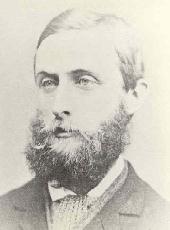
A brother writing some months before this sad division says, "Beloved
Lord A. [ P. ] Cecil had warned me in letters, which now appear quite
prophetic, of coming difficulties. He had found out several of the leading
opposers of Mr. Raven.
I give here an extract of Lord Cecil's letter, dated June 6th, 1888:
"The proofs of the divergent views of even leading brethren that I have had
as to these subjects are most distressing, and I fear must bring trouble some day, unless the Holy Spirit works.
- "Mr. — brings together new birth, eternal life, new creation, and the sealing of the Holy Ghost, and allows no room for the work of repentance in the soul, unless it is a natural repentance of an unsaved man, or else a repentance after sealing, which for the sinner is absurd.
- "If he is consistent, Romans 7 is with him, the experi-ence of a soul short of new birth. It is a denial of the truth of the Word, and of JND's teaching, and I believe that numbers of brethren are going with him in it.
- "It is going to the other extreme from FWG, but its effect I think would be to lead ignorant souls into his teaching; for F.W.G. teaches the same, only puts all on the low level of new birth, as might be true in Judaism, or when Christ was on earth;
- "whereas Mr. — brings up new birth to the full Christian level; but then, to be consistent, no Old Testament saint was born again, nor hose who lived while Christ was on earth. All these divergent views of brethren unsettle poor unstable souls".
- Indeed one who went out with Mr. Grant in America writes rejoicing that this brother, who is now a leader against Mr. Raven, is teaching Grant's doctrine. HDA'C
|
Page Top
Mr. Lowe Differs From JND in Making John 3: 5 and John 20: 22 Coincide – JND on John 20 and Acts 2
Mr. Lowe, I believe, holds that John 3: 5 and John 20: 22 now
coincide; while Mr. Raven (with JND also) maintains that John 20: 22 and Acts 2 go together;
- that though separated by an interval of fifty days in the case of the disciples, yet now the Spirit of life in Christ Jesus (Romans 8 and John 20: 22) is only known by the indwelling of the Spirit (Acts 2).
As to John 3, there are two side of new birth: one, "That which is born of the Spirit is spirit"; the other, the water, or Word, which our Lord mentions in John 3, but does not go further into.
- The one is the sovereign communication of a totally new life, so that a man is born again (anothen), while water, as JND says, cleanses what exists; it is the renewal of the affections, desires, etc. of the man by the Word.
- But this must be distinguished from the formation of Christ in the believer by the Holy Ghost, so that "he that is joined to the Lord is one Spirit".
- Christ, in Whom every holy desire and affection begotten by the Word is verified, now lives in the believer. "Not I live, but Christ liveth in me".
JND says of John 20: 22 (Collected Writings, vol. 33), "Although symbolising the Holy Ghost, He was not yet sent; but He was communicated as power of life by the risen Saviour – divine life – life according to the position in which He was, and which was its power.
- "They lived by the divine life of the Saviour, and according to the state He had taken in rising. The Holy Ghost descended from heaven (Acts 2) to reveal to them the objects of faith and lead them".
Page Top
A Mere Quotation the Chief Ground for Secession
– The Whole Letter shows that Mr. Raven Holds
the Truth as to the Person of the Son and
Eternal Life
The chief ground given by Mr. Lowe, Major McCarthy, and the rest who
seceded from the Lord's Table at Ealing on the 15th of June is the following quotation taken from a letter of Mr. Raven's to one of the brothers at Ealing:
- "The effort of many is to maintain that eternal life is a Person, and I am nor prepared to accept this. Scripture does not say that eternal life is Christ, but that Christ is eternal life".
I will now quote the whole letter. "I believe that 1 John teaches that eternal life was essentially ever with the Father in the Person of the Son, in Whom it was manifested by His incarnation to His disciples, and that eternal life is in the Son, who is the true God and eternal life.
- "The effort of many is to make out that eternal life is a Person, and I am not prepared to accept this. Scripture does not say that eternal life is Christ, but that Christ is eternal life;
- "i.e., that the heavenly condition of relationship and being in which eternal life consists, [Compare Mr. Darby's words quoted above. HDA'C] exists, and is embodied and
expressed in Him, and we in having the Son have eternal life".
From this letter it is clear that Mr. Raven believes eternal life to be embodied or personified in Christ, but that
- he is not prepared to hold that eternal life in itself is a Person, so that it is one of the three persons of the Trinity, or so that eternal life covers all that Christ is; for He is the true God and eternal life.
Scripture does not say He is the true God, that is, eternal life, but and eternal life.
To the letter quoted above, this brother in reply wrote: "Many thanks for your letter just received, which quite satisfies me, though I fear
some here will not be so.
- "I cannot, therefore, use it as intended. [That is, publicly, as his first letter shows. HDA'C] It may however be very useful if the Lord gives opportunity, and one needs guidance".
Page Top
C.S.'s Definition of Eternal Life Not Correct
In spite of this answer Mr. Raven's letter was published, or rather a
quotation from it, and that without further notice of it to Mr. Raven.
- And it is this quotation which has been the chief handle of the devil in this division.
- Mr. Raven told me that he could not accept Mr. Stanley's definition of eternal life "that it is a Person, the eternal Person of the ever
blessed Son of God",
- and that it was to avoid this, and to protest against this, that he expressed himself as he did in the letter alluded to above.
He said to Mr. Stanley, "The Son of God and eternal life cannot be made
equivalent terms. The Son of God is more than eternal life He is God, and the giver of eternal life.
- "And too, you cannot apply every expression as to eternal life to Christ personally. The righteous go into eternal life (Matt. 25). You cannot here substitute Son of God for eternal life".
Compare Letters of F. E. Raven, page 12, lines 6-15.
The texts vary but seem to convey the same thoughts. GAR
|
Page Top
An Opposer of Mr. Raven says Eternal Life is God!
A leader in this sad division told me that he believed it correct to say
that eternal life is God!
- If so, we ought to pray to eternal life, and worship eternal life as such.
- I would indeed adore and worship and pray to Him Who is that eternal life, which was with the Father, and has been manifested to us, and hold dear His sacred person;
- but I do not think that Scripture teaches us to pray to God in the name of eternal life, or to worship eternal life as such.
- I hesitate to enter into such a sacred subject, and should never have done but for the effort of Mr. Raven's opposers to force him into accepting Mr Stanley's unscriptural definition of eternal life. HDA'C
|
Page Top
A Statement considered as Profane
as anything Mr. Raven has Written
A dear brother (another leader in this division) to whom I wrote to this
effect says:
- "You see no blasphemy in Mr. Raven's teaching, and your own letter is as profane as anything I have seen from Mr. Raven's pen", etc.
- The language of this brother was so strong that it made me wonder
whether in writing to him I might not have gone too far in seeking to state
the truth; so I wrote to ask him for the words he considered so profane, and he sent me the following extract of my letter:
- "Of course, if you wish to press him (Mr. Raven) into personifying
eternal life, so that we are to worship eternal life, and pray to eternal life, and make the true God and eternal life equivalent terms, I cannot go with you".
- And these words are "as profane as anything Mr. Raven has written".
- Not that eternal life is not personified in Christ as man, but that it is not personified in the sense of eternal life in itself being a divine person, and commensurate with God.
- Not content with our freely admitting that eternal life is personified in Christ, Mr. Lowe's party intrude on sacred ground, and would force us to admit that eternal life is in itself a person, which, if true, involves that the Person – Eternal Life – must be worshipped and adored as such. HDA'C
|
I say that it is utterly unscriptural on their part to make God and
eternal life equivalent terms, to say that eternal life communicated to
us is God, and all that God is, or to
- limit the blessed person of Christ, who is the true God, to that eternal life which every believer has.
- Some of Mr. Lowe's party are now saying "eternal life is a title of Christ". It is no more a title than "the resurrection" is in "I am the resurrection and the life".
Page Top
Eternal Life is Christ and that Revealed as Man in Glory
– Mr. Raven does, however, accept
the Personality of Eternal Life
Mr. Raven has quoted with approval the following words of Mr. Darby: "As to eternal life in the full sense of it, it is Christ Himself, and that revealed as Man in glory. But its essence is divine life in the Person of Christ" (Reprint of letters of JND, published by Morrish).
- I myself asked him (Mr. Raven) whether he believed this, that
eternal life in its full sense is Christ, and that revealed as Man in glory.
- "Yes, certainly". "It is alleged you do not". He answered with indignation that it was utterly untrue.
- "You accept then the Personality of eternal life?" He answered: "I do, if you mean that it is Christ; but not if you mean that the Person (Christ) is neither more nor less than eternal life". "He is the true God, and eternal life".
The "true God" and "eternal life" are surely not one and the same
thing. There is no article here in the Greek before eternal life which shows that it is predicative.
- It is often dangerous to interchange things in Scripture, e.g., "God is love"; but who could say, 'Love is God'?
- Again, "the Word was God", i.e., a divine Person; but who would say, 'God was the Word', or substitute 'the Word' instead of God, in "God so loved the world, that He gave His only begotten Son"?
- How careful we should be lest in stating what Scripture does not state we fall into error and nonsense. If eternal life is God, then we are gods and have deity.
Page Top
Example of the Folly of Making a Man
an Offender for a Word
We should be careful, too, not to make a man an offender for a word
(Isa. 29: 21). For example, a brother writes: "Eternal life is the
capacity of enjoyment".
- Am I therefore to call him a heretic, and say that he denies that eternal life is Christ? No; I must read on, and see whether somewhere else he does not clearly state that it is Christ, and then try to understand what he means by "capacity".
- A brother to whom I wrote this, thinking probably that these words were Mr. Raven's, replied: "To state that eternal life is the capacity of enjoyment is a root error, and nonsense on the face of it".
- But the words are not Mr. Raven's, but Mr. Darby's! yet Mr. Darby was not a heretic, for he distinctly held that Christ is eternal life.
- Mr. Raven, too, in the very words preceding the statement, "Eternal life is a sphere", says, "He is it", i.e., Christ is eternal life. (See letter of Mr. Raven, quoted by Mr. Stanley.)
Compare Letters of F. E. Raven - New Series,
page 13, lines 13-16. Again the texts vary. |
Page Top
Mr. Raven says that We Have Eternal Life
– It is Christ – such as could be
Connected with Manhood and Imparted
Also in his little pamphlet, just published, on eternal life, he says: "It is a life which has its source and spring and seat in Christ. It is
Christ. Eternal life is given us, and is in the Son, and we have it as having Him".
Compare Letters of F. E. Raven – New Series,
page 43, lines
21-22, 27; page 44, last line; page 45, line 1.
|
But as to what eternal life is essentially (in relationship and moral being), it was ever with the Father in the Person of the Son, and manifested in Him to His disciples here.
- It was ever an integral part of the Person of the eternal Son, but as such could, according to the divine counsels, be connected with manhood,
and be imparted to men.
- But we must remember, that in addition to this there is the incommunicable glory of His Person as the only begotten Son. "He is the true God and eternal life".
Page Top
Satisfactory Explanation of Mr. Raven's Words that
"Eternal Life is a kind of Technical Expression"
Mr. Raven has been bitterly attacked for speaking of eternal life as "a
technical expression".
- Love would have first asked him what he meant by it, as someone else did, to whom Mr. Raven answered to the following effect:
- That a technical expression is one which does not convey what is meant in actual words: a person must know the subject to understand it.
- For example, the millennium to most would simply mean a period of a thousand years, and how could one tell its character without knowing more than a word? It might be a thousand years of suffering or misery.
- Eternal life – the mere words – would convey nothing more than living for ever to those who know nothing else about it.
- The Jews had certain ideas of eternal life, and it has a different meaning as applied to the earthly or heavenly (Matt. 25: 46). Eternal life stands in contrast to responsible life and sin and death.
Page Top
Accused of Teaching that Righteousness is Future
– Righteousness Not Progressive
There is one more charge brought against Mr. Raven; viz., that he
teaches that we are not made the righteousness of God in Christ till we
get to glory, and other equally false charges on this subject.
- I will quote Mr. Raven's own words: "I judge that 2 Cor. 5: 21 in its full scope refers to the saints becoming in Christ in glory the witness or expression of God's righteousness, because that righteousness was displayed in setting Him there … The believer is in Christ, and, as there, is become God's righteousness in Christ. It is in no sense a progressive thing in him, nor dependent on his practical state or experience".
| Letters of F. E. Raven – New Series, p. 16, note ‡.
|
- "We are justified in the scene of our responsibility, and as a consequence have peace with God. But divine righteousness in its fullest sense is seen in that the One that was in death for the glory of God, is now the living Man in the glory of God … and we for who He was made sin have life in Him there, and are a new creation in Him, and as such become God's righteousness in Him".
| Mr. Raven on "Eternal Life", and also letter of March 21st.
|
At a reading of brethren Mr. Raven stated, "I hold that as believers,
we stand before God in righteousness now, and that, being in Christ and
belonging to a new creation, we have become 'the righteousness of God in Him' ".
Page Top
 "As to what you refer to, my point was that it was permitted us to know divine Persons as and when revealed and only so.