| INTRODUCTION |
|---|
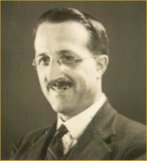
All the known published ministry of Mr. G. R. Cowell is summarised in his biography.
| The early ministry consists of all GRC's ministry, 1936-1960 – except for the separate 'Memorials' series for the same period – from the beginning of his recorded ministry up to July 1960 when he was unrighteously excommunicated by the legal sect. |
|---|
The addresses – which have been out of print for many years – are all of spiritual quality and is my prayer that those who read them may
|
G.A.R.
| GREATNESS |
|---|
| Hebrews 1: 1-3; 8: 1-2; Ephesians 2: 4-6 Acts 2: 1-2; 2 Samuel 7: 18-24 Adress at Weston-super-Mare, July 7, 1945 Words of Grace and Comfort, 1947, 23: 105-14 and Ministry of G. R. Cowell, Booklet 5: 3-13 This 1945 address should not be confused with Greatness a series of readings on Hebrews in Toronto, October 1957. |
I desire to say a word on greatness, because God would have us become accustomed to greatness.
Hebrews 1 and 8 refer to the greatness of Christ in a striking way, particularly the former. It is essentially the chapter of greatness as regards Christ.
In this chapter the Scriptures, particularly the Psalms, are quoted extensively to bring out the greatness of Christ.
The Son is said to be "the effulgence of His glory and the expression of His substance"; thus the One in whom God speaks is entirely in accord with the speaking.
I would like to commend that expression to you, because the Lord Himself is ineffably great, and yet as Man He has set Himself down at the right hand of the Greatness.
Before I pass on I would just say this: love enters into the whole matter. "Taking a place by so much better than the angels".
But now in chapter 8 it is Christ on our side. In chapter 1 we see Christ on God's side, the One through whom God speaks, and in that respect He must be alone in all His greatness, but in chapter 8 the apostle says,
We are a part of the true tabernacle which the Lord pitched and not man; we are in immediate proximity to the throne. We must not be geographical in our thoughts.
We are before Him as sons. The more we enter into the relationship of sons the more we shall cherish the thought of greatness, the greatness of the One we know as Father, His ineffable greatness as God.
But then there is the question of the greatness of the saints. In thinking of the greatness of the saints we need to be very careful always to maintain that Christ's greatness is outstanding.
It is a great thing to see that the assembly is a necessity to Christ and to God. God will never dwell with angels in that sense. God dwells with men.
Yet in whatever setting we see Christ, in their measure the saints correspond with it.
And so when you come to the thought of sitting in heavenly places, Ephesians shows that the saints are brought into correspondence with Christ in their measure.
Acts 2 refers to the public position down here corresponding with our place above. The saints were together with one accord in one place, and Christ was enshrined in their hearts.
I read the passage in Samuel as an encouragement to us to be like David and to go in and sit before the Lord.
As we sit there we become impressed with a sense of greatness, we are in the presence of greatness, so David says here – verse 21 –
May we spend more time in the presence of Divine Persons! We find time for other things, why not find more time for this?
| THE GOSPEL OF GOD: WHAT IT IS, WHERE IT IS AND WHERE IT LEADS |
|---|
| Romans 1: 1-6, 16; 16: 25-27 2 Timothy 1: 6-9, 15; 4: 6-7; Colossians 1: 23-26 Address at Marseille, France, November 5, 1956 Words of Grace and Comfort, 1957, 33: 125-33 |
I wish to speak a few words about the gospel; firstly, as to what it is;
secondly, where it is, and thirdly, where it leads.
I would ask everyone here whether he or she stands for the truth of the gospel.
The first Scripture shows that the gospel was committed to Paul in a special way.
Now the first question I wish to raise is, What is the gospel?
We can have no doubt therefore, as to who is the subject of the gospel. God's Son is the subject.
But then Paul adds, "and the preaching of Jesus Christ", Romans 16: 25.
I will now move on to my other question, i.e., Where is the gospel?
Then he says, "All who are in Asia, of whom is Phygellus and Hermogenes, have turned away from me".
At the beginning of the church's history, there was indeed the reproach of Christ, but there was not the reproach of the broken state of Christendom such as exists today.
In those days, I might have gone to Ephesus and asked, Why have you left Paul?
My third point is, Where does the gospel lead? The last few verses of Romans make it clear where the gospel leads.
We cannot separate the gospel from the truth of the assembly, the mystery. The gospel is "according to the revelation of the mystery".
Paul thus had two great ministries committed to him; but the basis of all was the full declaration of God by our Lord Jesus Christ, who alone could make God known and declare His Name.
We can see thus how the ministry of the assembly completed the word of God.
Someone may say, There are very few Christians who do it.
Let us take courage. Let us not be ashamed of the gospel of God. Let us encourage one another as Paul did Timothy:
Then at the end of the epistle comes an urgent request from the beloved captive in the Roman prison. "Use diligence to come to me quickly". Shall we give heed to this?
Beloved brethren, the gospel from that Roman prisoner has reached us in France; it has reached to England, to America, to the utmost parts of the world.
I trust these words will encourage our hearts. May the Lord help us all!
| SEPARATED FROM EVIL AND SEPARATED TO GOD |
|---|
| Numbers 19: 1-6, 9, 17-20; 6: 1-6 2 Corinthians 6: 14 (first clause), 16-18; 7: 1 Nehemiah 12: 27, 31, 36 (latter part: "with … them") - 40, 43 Address at London, July 16, 1958 Included in Ministry by S. McCallum Distinctiveness and Finality in Paul's Ministry: 168-83 |
I wish to say a word, dear brethren, on separation from evil, and separation to God. Numbers 19 deals with separation from evil and Numbers 6 with separation to God.
I think we can see that in Abraham's case there was not only separation from evil, but also separation to God;
In Numbers, Balaam remarks as to Israel, "it is a people that shall dwell alone and shall not be reckoned among the nations", Num. 23: 9.
In his epistle, John speaks of our dwelling in God, and God in us.
God is the living God, and He is the loving God, and nothing will satisfy Him but full-hearted responsive love from His people. He is a jealous God, because He is love.
He had come to dwell among His people in such a city as Corinth, and, in spite of their state, He had not left them.
"And touch not what is unclean, and I will receive you". He is longing to receive us in the sense referred to here.
And so this appeal comes to us, and I want to reinforce the appeal by referring to Numbers 19.
And this is to be before our eyes. Paul put it before the Galatians' eyes.
We may sometimes overlook a little phrase in Hebrews 9: 13.
We should have no access to God, indeed we could not even approach the tent of meeting, without the death of Christ in this character.
The thought of the ashes should affect us profoundly.
The water of separation – note the word 'separation' – was made from those ashes. It was a purification for sin; Num. 19: 9.
And so it goes on to speak of one who touches a dead person, any dead body of a man (v. 11).
"Who shall deliver me out of this body of death?" The ashes are the witness to our deliverance at such a cost.
Romans, chapter 8, shows how the Spirit makes the deliverance effective.
The word in 2 Corinthians 6: 17 is, "touch not what is unclean".
But the water of separation is available and we would like, at a time like this, to sprinkle these ashes on one another, that is, to bring this aspect of the death of Christ home to the conscience and heart,
And, because God is not the centre, you will find a good deal of cedar-wood and hyssop and scarlet, all of which according to this chapter, went into the burning.
Now I wish to go on to Nehemiah, because it speaks there about the dedication of the wall. It is dealing with days of recovery and a good deal had preceded.
That start of things, according to the book of Ezra was remarkable. The returned captives must have studied the Scriptures closely, because it says
I believe, dear brethren, this specially links with the present time.
Now what about the wall today? Is there a breach left in it? This is the time for seeing that there is no breach left in the wall.
In Nehemiah 12, when the wall was completed and the gates were erected, there was the dedication of the wall. It was the culmination of joy.
Now I want to say a word about dedication. There was the dedication of the house earlier (Ezra 6: 16), and now the dedication of the wall.
In the recovery, every person who is vitally in it, is a Nazarite. Indeed in Christianity, what was special of old is normal; Nazariteship is normal.
And see how remarkable are the movements of the two choirs upon the wall! Without the wall we could never maintain the service of God; it is impossible.
The first one, with Ezra in front, had the musical instruments of David the man of God.
The second choir, in the opposite direction, with Nehemiah behind them, began at the tower of the furnaces, where all the rubbish was burnt.
Thus the first choir is the upward line – the service Godward
You may say, 'If I accept separation in the way you are speaking, my wife and children will suffer'.
Now I want to say one more word. The second choir was going over the ground of administration manward, ending at the prison-gate;
In the representation of God in the living creatures in Ezekiel 1: 10, we have the lion, and the lion roars sometimes as the prophet Amos indicates.
More could be said as to the great heights to which the note of praise rose, once the wall was completed.
May the Lord help us for His name's sake.
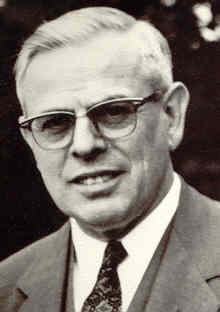
NoteMr. G. R. Cowell gave the preceding landmark address at the London Special Meetings with Stanley McCallum – of Detroit – in July 1958.SMcC photo at right. The address appeared in the Stow Hill Depot publication, of notes of those meetings, now out of print, entitled Distinctiveness and Finality in Paul's Ministry, pages 168-83. G.A.R. |