Menu•SiteMap |
History
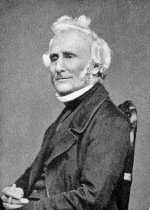
John Nelson Darby:
An Unfriendly Appraisal
INTRODUCTION and Editorial Note |
| This article may seem to contravene MB's Site Standards
and would not have been accepted as a current submission.
An exception has been made because of its historical value.
For an explanation of MB's position on this article, see the
following 'Introduction' and the notes throughout. GAR
|
This article is from a very faint typescript of an article by Professor George T. Stokes which appeared in 'The Contemporary Review', October 1885, Vol. 48: 537-552.
- The author also wrote 'Plymouth Brethrenism: Its Ecclesiastical and Doctrinal Teachings; with a Sketch of Its History', London: Hodder and Stoughton, 1874.
- Mr. Stokes professed to be a Christian – referring to "our Lord" twice – and claimed to be a "well-read historian".
A historian's chief responsibility is to present thoroughly researched and authenticated facts, objectively and free from personal bias.
- On this rests his right to public recognition as a scholar, as well as his personal integrity.
- Only when these conditions have been fulfilled has he the liberty to draw moral or spiritual lessons from the past.
The Professor's article is seriously flawed by a thorough lack of objectivity and impartiality and
- an openly hostile attitude towards Mr. Darby, the brethren, and all those he labels 'Separatists', discounting their virtues while displaying
delight in their failings.
- Therefore, although his article is written in an engaging and persuasive fashion, it cannot be recommended to the "untaught and ill-established" who are like "babes, tossed and carried about by every wind of that teaching which is in the sleight of men", 2 Peter 3: 16; Ephesians 4: 14.
Mr. Stokes' avowed object is "to show his [Darby's] influence at a great religious crisis, and to explain the origin of his followers".
- The discerning reader will judge how far he has confined himself to, or achieved, his stated purpose.
The Professor only refers to a few of Mr. Darby's very early writings.
- Otherwise, most of his information – personal
opinion and prejudice cannot be dignified as facts – regarding JND,
and the brethren,
- is drawn from the writings of F. W. Newman, A. N. Groves, and the latter's biographer – unfriendly, if not hostile, sources –
- and from encyclopedias, not noted for intimate and personal knowledge of their subjects.
- It may be argued that a person's 'influence' can best be ascertained by his effect on others.
- There is an element of truth in this but, as with the historian, the value of such testimony must be assessed on the basis of the objectivity and impartiality of the source.
Some might deem the author's intention to show "the range of his influence, which embraced and shaped – directly or indirectly – the lives of men celebrated in the world of thought and literature" as justification for the extensive coverage of Newman.
- But strangely, Newman is the only person brought forward as "shaped – directly" to demonstrate Darby's range of influence.
Newman is portrayed as always needing and looking for external and visible support.
- It is said that he "bowed" to the Bible but there is no evidence that he bowed to the Lord Jesus.
- Mr. Stokes is eager to exonerate Newman from all accountability for his own personal uncertainty and ultimate apostasy, and to fasten
the full responsibility on Darby –
- based solely on the accusations of a self-confessed infidel whose 'Phases of Faith' is an open attack on the revelation of God in the Bible to which he once "bowed".
If the Professor had troubled himself to read 'The Irrationalism of Infidelity', JND's reply to 'Phases of Faith',
- he might have reached an entirely different conclusion as to Newman – and not have boldly sallied forth as self-appointed champion of the cause of infidelity.
- Mr. Darby's opening personal note is very affecting, showing the depths of his feelings for Newman, and his hopes of recovery for one who had once professed "spiritual delight" in Christ.
But if the foregoing is a sound judgment of the article, it may be
asked, why bother reproducing it? There are two reasons.
Firstly, it demonstrates how far JND, and the brethren, had come under public scrutiny and the extent of the prejudice towards them.
- This is of singular interest in these days of brokenness and obscurity.
Secondly, and on the positive side, Mr.
Stokes is to be credited for the details – though not his evaluation – of John Walker and his followers,
- as well as his comprehensive analysis of what he terms "the secular and Erastian spirit then prevalent in the Church".
- Particulars on these two important topics might not have been readily accessible, or the subjects might not, otherwise, have come to the attention of some readers.
- In addition, the sections on Newman and Groves both contain some little-known but interesting points to students of the history of the revival.
In our own investigation of the course of the testimony, we ought to take to heart the professor's axiom that
- "of no period are men so densely ignorant as of that which immediately precedes their own time".
- May the reader use intelligence and discernment – 1 Cor. 10: 15 – separating the wheat from the chaff.
G. A. R.
| Minor corrections have been made. Notes, unless otherwise indicated, and text in [square brackets] are mine. The section headings are new and have been derived from the text. GAR
|
Page Top
| JOHN NELSON DARBY |
| 'An Unfriendly Appraisal' |
Early Life
On April 29, 1882, there died at Bournemouth, at the age of eighty-one, John Nelson Darby, whose life exercised a profound and very varied
influence.
- He founded a somewhat obscure sect, indeed, but a brief sketch will show how much wider was the range of his influence, which embraced and shaped – directly or indirectly – the lives of men celebrated in the world of thought and literature.
John Nelson Darby was born at Westminster in the year 1800, of a highly honourable family in King's County, the Darbys of Leap Castle.
- He was thus by accident of English birth, but otherwise was
thoroughly Irish.
- He entered Trinity College, Dublin, as a fellow-commoner at the age of fifteen and graduated there as Classical Gold Medallist, when little more than eighteen years old, in the summer of 1819.
His father had destined him to the Bar, but though called in due course, he soon abandoned the din and bustle of the law courts for the calmer pursuit of the clerical life after which he had ever longed.
- He was of a profoundly religious spirit by nature, and in the days of his earlier manhood – between 1820 and 1825 – strove to satisfy that spirit by all the practices of strict Churchmanship.
- In 1825 he was ordained deacon, and in February 1826 priest, by the
celebrated Dr. Magee, Archbishop of Dublin, grandfather of the present Bishop of Peterborough.
Darby soon came into collision with the prevalent religious spirit of Dublin.
- Archbishop Magee and the Dublin clergy had taken alarm at the impending emancipation of the Roman Catholics.
- The Archbishop delivered a Charge, and the clergy published a declaration addressed to Parliament, denouncing the Roman Catholic Church,
and claiming special favour and protection for themselves on avowedly Erastian principles.
| Erastianism: Doctrine of Erastus, a 16th century Heidelberg physician, subordinating ecclesiastical to secular power.
|
- They based their demands simply on the ground that Romanism was opposed to the State, while their own system was allied with, if not even subservient to, it.
Darby's mind revolted against such a miserably low unspiritual view of the Church.
- He drew up, therefore, and circulated privately a very vigorous protest against the action of the clergy, a sufficiently courageous step for a young curate of two years' standing.
- This protest Mr. Darby republished fifty years later in the first of the thirty-one volumes of his 'Collected Writings'.
| It is more likely that William Kelly, 1821-1906, editor of the 'Collected Writings' – now 34 volumes – was responsible for the republishing rather than the aged JND. GAR
|
- It is a very interesting document when read in the light of subsequent events, and explains the intensely Erastian tone in the Church of that day, of which the early 'Tractarian' writers so bitterly complained, and against which they so consistently struggled.
| Tractarianism: That stage, 1833-41, of the Oxford Movement when the 'Tracts for the Times' were being issued by such authors as J. H. Newman and E. B. Pusey. GAR
|
Darby's protest was unavailing. The Establishment was everything with the Churchmen of that time, the Church of God was nothing regarded, and Darby's soul was vexed thereat.
- He looked around, therefore, for some body which might answer his aspirations after a spiritual communion based on New testament and religious principles, and not on mere political expediency, and soon found it in a society, or rather an unorganized collection of societies, which had been for many years growing and developing, and which under his
guidance was destined to take final shape in the sect now called the
Plymouth Brethren.
| This is the first of several subtle efforts to identify Mr. Darby, and other early brethren, with John Walker and the so-called Separatists. For the facts, see
The Early Years – Recollections. So many baseless insinuations and statements are made that only the most glaring and intolerable can be noted. |
Page Top
Evangelicalism
We cannot understand the course subsequently pursued by Darby unless we first take a retrospective glance over the very curious and striking religious phenomena presented by the Church in the reign of George IV.
- It is often remarked, and with much justice, that of no period are men so densely ignorant as of that which immediately precedes their own time.
- Every man of ordinary education can tell the details of the great Civil War, or the Revolution of 1688, or even the leading events of the French Revolution.
- How few can give any correct account of Roman Catholic Emancipation, the Tractarian Movement, the Corn Law League, or the Papal Aggression.
- Yet men are well acquainted with these names, and their very acquaintance helps to cheat them into a belief that they know something about the history thereof.
| It is true in spiritual matters. Most believers are acquainted with scriptural terms, but few understand the teachings of Scripture and fewer still put them into practice. GAR
|
Now to understand the principal religious movements of the present age, the Broad Church and the Oxford movements, as well as the great disintegrating movement of 'Plymouth Brethrenism',
- we must realize the prominent religious features of the days of the Regency and of the reign of George IV.
- In the first twenty-five years of this century the Evangelical
movement was in full swing of prosperity. Externally its prospects were brightening every day.
- The Church Missionary Society, the Bible Society, and numerous similar institutions attested its zeal and organizing power.
- Internally, however, a canker-worm had already attacked its life.
| In this article, the term 'Evangelical' – in its various forms – usually, if not always, refers to movements or persons within the Established Church. It does not have the broad significance to which present day readers may be accustomed. GAR
|
Among the leaders of the party, about the year 1800, no one held a higher position than the Rev. John Walker, fellow of Trinity College, Dublin, and chaplain of the Bethesda chapel, the head-quarters of the
followers of Whitefield and Lady Huntingdon in the Irish capital.
| This should not be confused with 'Bethesda Chapel', Bristol, with which George Muller was associated. GAR
|
- Walker held and taught an extreme Calvinistic creed, which he bitterly and vigorously defended in a prolonged controversy with the celebrated Irish layman, Alexander Knox, the real father of the Oxford movement.
- But he very soon grew weary of even a very nominal conformity to the Church system. He recognized instinctively that its fundamental idea, was contradictory to his own, which made God's secret election and its manifestation in conversion the only basis of Church membership and communion.
- In the year 1804 he formally seceded from the Church, and established a sect called [by others] 'Separatists' or 'Walkerites', which will still be found leading here and there a lingering existence in Birmingham, Dublin, and a few other large towns.
- Their principles are very similar to the 'Brownists' of Queen Elizabeth's time.
- Walker held the extremest form of Calvinistic doctrine, rejected ordination and an appointed ministry, practised close communion, refusing to admit any save his own followers to the Holy Communion,
- and taught that he could not even pray or sing with any others, as the prayers of the wicked – under which amiable category he classed his opponents – were an abomination to the Lord.
- This sect decayed, indeed, but its principles survived and exercised a very corroding influence on the labours of the Evangelical party all through the first quarter of this century.
| In 1971, C. P. Martin was Emeritus Professor of Anatomy at McGill University, Montreal. About that time he wrote an interesting and informative account entitled 'Recollections of the Walkerite or so-called Separatist Meeting in Dublin'.
Dr. Martin – whom we assume is no longer living – was "one of the last surviving members of the Dublin Meeting", and says "I joined
the meeting in 1905 when I reached thirteen years of age". He calls "attention to the posthumous edition of Walker's papers and letters":
'Essays and Correspond-ence, Chiefly on Scriptural Subjects', collected and prepared for the Press by William Burton. Two volumes. London: Longman, Orme, Brown, Green, and Longman's; E. Madden and R. M. Tims, Dublin; A. and C. Black, Edinburgh, 1846.
Dr. Cronin mentions a "Mr. Tims – bookseller in Grafton Street" as meeting with him and others in his Dublin house before they met at F. Hutchinson's house in FitzWilliam Square. See History: The Early Years – Recollections. GAR
|
The Separatists pursued the leading Evangelical teachers everywhere;
poaching upon their congregations, robbing them of their most devout
adherents,
- and representing themselves as specially spiritual in contrast with the Evangelical clergy, whom they described as hankering after the flesh-pots of Egypt, meaning thereby the endowments of the Church Establishment.
One instance will illustrate the pertinacious character of their attacks. Among the most pious and devoted Evangelical leaders of that day was the Rev. Peter Roe.
- Like so many others of that party, he was an Irishman, who was as well known, however, in London and Bath, as in Dublin or his own city, Kilkenny, where he ministered.
- His biography – which can often be picked up for a shilling on a
bookstall – is a singularly heavy book for persons in pursuit of light reading, but for those desirous of tracing the changes of religious thought, it is full of interest.
- From that book we learn that the Walkerites were so successful in their efforts about the year 1815, that Roe, together with the two leading English Evangelicals of that day, Messrs. Simeon and Leigh Richmond, published a volume called 'The Evils of Separation', to warn their followers against their tenets.
- Yet, notwithstanding all their denunciations, the Separatist societies
– in virtue of their more logical position – flourished
and increased, especially in the West of England, Exeter, Plymouth,
Bristol, as well as in Dublin and many other places throughout
Ireland.
| Another of the many attempts to link the origin of the
brethren with the Walkerites or Separatists. GAR
|
Page Top
Secularism
Another influence told powerfully in their favour. Young Darby,
as already mentioned was intensely disgusted by the open and avowed
Erastianism of Archbishop Magee and his clergy.
- In his opinion they had lost all sense of what a Church is, and were desirous of reducing it to a department of the Civil Service, and he was not far wrong.
- Dr. Magee's charge was only an illustration of the intense secularism
which then pervaded the Church, a topic upon which the Separatists
were continually harping.
The Evangelical party did but little to remedy this. They acted in that period as in our own day, hesitating to devote much attention to corporate Church action.
- They stirred up individuals, but neglected work and life organized on a Church basis.
- In fact, the idea of a Church with its organization and discipline found only a very subordinate, if indeed, any place at all, in their system.
The High Churchmen, again, of that generation were simply ultra-Protestants of a political type.
- Macaulay has depicted the High Church feeling of that age in his ballad on the 'Country Clergyman's Trip to Cambridge'.
- The term High Churchman, indeed, now betokens anything save a rabid Protestant, yet it is a curious fact that in rural districts of Ulster the phrase High Churchman still retains its Georgian significance, and denotes a Protestant of the popular Orange type.
- The High Churchmen, then, of that day could lend no help in combating the prevailing Erastian tone.
- And yet the intense secularism pervading the Church some sixty years ago was something of which the men of this generation have no conception.
- The study of the popular literature of that time will alone reveal it.
Let us take an instance. The careful student of the old bookstalls will sometimes come across a curious work called the 'Parson's Horn Book', published more than fifty years ago.
- A glance through its pages will show what was the popular idea of the higher clergy of that age, when a bishopric, in Ireland at least, was esteemed a fair and fitting provision for the younger son of a noble house.
- It will explain, too, the intense dislike manifested by the Separatists to the very idea of a Church Establishment.
The 'Horn Book' is a very scurrilous pamphlet indeed; it depicts the wealth and neglect of the clergy in the darkest colours, and much of it was doubtless exaggerated.
- Yet there must have been some foundation for the satire, or it would not have taken with the populace.
- The following lines are a fair specimen of it. They are taken from a piece called the
Devil's Shooting Excursion.
The month was November, the morning fine,
The clock had just struck half-past nine,
The devil had swallowed his coffee and toast,
And sat by the fire perusing the Post.
| The popular Protestant Dublin Paper of the time. GTS
|
"A rare morning", cries he, "ho! my dog and my gun,
I vow I must forth for a taste of fun".
Then after noting his various preparations for sporting, the
poem proceeds —
Away he walked adown his farm,
His tail like a lady's train over his arm,
His gun on his shoulder, his dog by his side,
And Cerberus casting in three-headed stride.
What a set! to ho! to north, west and east
Pointed at once the well-trained beast.
When up from the stubble three parsons arose
With a sluggish wing like their cousins the crows.
Bang! Bang! down came two while the third wends on.
The Devil chuckles and cries well done!
Coolly he picks up and bags the slain,
They were fat and their craws were filled with grain.
Six bishops next he met in a bevy
And rustling along in pomp to levee;
And as they cunningly schemed in pairs,
How each was to broach there his little affairs,
The Devil came on them unawares.
From the aproned lot a brace he picked,
Tenaces Vita and though ripe melons,
They died as hard as hardened felons.
It is difficult for us to realize how such lampoons could have
been popular, but then we can have no idea how secular in that time
the higher clergy were.
- Two practical examples, however, one drawn from Ireland, the other from England, will help to explain the state of religion which led Darby and men like him to look for a true spiritual Church elsewhere than in the Establishment,
- and which, at the very same period, stirred up Hugh James Rose and the early Tractarians to combat that secularity and to revive the spiritual idea of a Church within the bounds of the same Establishment.
One of the best known Irish clergymen in the early part of the century was the Hon. and Rev. Power le Poer Trench, last Archbishop of Tuam.
- He was ordained in 1792. The same year, he was appointed Rector of Ballinasloe – his family seat. Promotion after promotion rapidly followed.
- In 1793 he was appointed to the Union of Rawdenstown, in the diocese of Meath, which he held together with Ballinasloe.
- At the same time he was made land agent on the extensive estates of his father, the Earl of Clancarty.
| The custom of dignified clergymen holding large land agencies only died out within the last twenty years. The last of the race was the Dean of
Ross. He held a deanery in Cork, the rectory of Lisburn, and was agent over the vast property of the Marquis of Hertford, now owned by Sir R. Wallace, MP. GTS |
- Further still, he was captain of the Yeomanry in 1798, and scoured the country day and night hunting the insurgents.
- In 1803 he was appointed Bishop of Waterford, whence he was soon after transferred to the richer See of Elphin.
- In the year 1803 the White-boys were very troublesome. They assembled on one occasion to destroy the turf-stacks raised on the bogs of Elphin, the episcopal residence. This was too audacious a proceeding for the bishop to overlook.
- So he called out a detachment of the Enniskillen dragoons, and dispersed the rioters, riding so fiercely in pursuit that the troopers tumbled off their horses while trying to keep pace with a prelate whose military and equestrian vigour quite equalled that of Synesius, the celebrated North African prelate of the fifth century, whose hunting fame Kingsley celebrates in his 'Hypatia'.
- Yet all this time Bishop Trench was regarded as quite a model clergyman.
- This, however, was only Ireland, says the self-satisfied Anglican. Yet
England was not one whit better.
- A simple reference to the well-known case of Bishop Watson amply proves this, for a careful study of his extensive works will show that politics, agriculture, chemistry, and scheming for promotion occupied his whole attention.
These two instances are fair specimens – and I have by
no means chosen the most extraordinary ones – of the secular
and Erastian spirit then prevalent in the Church.
Page Top
Bellett and Groves
The formation of the Plymouth Brethren sect is due to two men whose names are unknown to this generation.
- One was Anthony Norris Groves, of Exeter; the other was a Dublin barrister named Bellett.
Groves was once well known as a wide and cultivated traveller, and specially as the friend and patron of Dr. Kitto, the Biblical critic.
Groves was born in 1795; established himself as a dentist first at Plymouth and then at Exeter, where he rapidly accumulated a large fortune.
- When thirty years of age he determined to take holy orders, having been deeply impressed by the preaching of the Evangelical clergy at Plymouth.
- With this view he entered Trinity College, Dublin, about the year 1825, where he soon came in contact with Bellett and Darby at the drawing-room meetings for prayer and study of the Scriptures,
- which even still take the place of lighter amusements in a somewhat extensive circle in the Irish metropolis, and which then were quite the rage with all serious minds.
These meetings were largely under the influence of what we have styled 'Separatist' views.
- Their leaders were disgusted with the political Protestantism then in vogue.
- They regarded as sacrilege the imposition of the Holy Communion as a mere political test.
- They could not help contrasting the very mixed and very unfrequent
Communions which resulted with that spiritual feast of which the New
Testament speaks as celebrated every Lord's Day at least.
- The train was now laid. The materials for an explosion had all been long and carefully prepared. The match was soon applied.
In the year 1826 Groves attended at one of the Bible Readings to which I have alluded.
- Mr. Bellett was then present, when Groves said to him,
- 'It appear to me from Scripture that believers meeting together as disciples of Christ are free to break bread together, as their Lord has admonished them; and in as far as the practice of the Apostles can be a guide, every Lord's Day should be set apart for thus remembering the Lord's death and obeying the Lord's command'.
- This suggestion was at once carried out by himself and his friends in Dublin.
- This, says his biographer, was the beginning of what is termed 'Plymouth Brethrenism'.
Mr. Grove's biographer could not have read Mr. Bellett's own account Early Years – Recollections.
JGB said it took place on the street and says nothing of it being put into effect. GAR
|
Events now moved apace. Groves and Darby imbibed scruples about the doctrine and discipline of the Church.
- They rejected ordination, and hesitated about the lawfulness of a Church Establishment.
- Groves at once relinquished any intention of taking holy orders, but Darby did not at once surrender his clerical position.
- Before he did so, two remarkable men appeared on the scene, and largely
modified his future course. These two were Edward Irving and Francis William Newman, brother to John Henry Newman.
Page Top
Prophecy
Let us take Edward Irving first. The men of this generation have very little idea of the vast influence exercised by the weird, majestic
eloquence, the seer-like utterances, the colossal person of the famous
Scotch preacher.
- Ministers of the State, noblemen, theologians, literary men, all ranks and conditions of society, were led captive by him.
- His teaching, which was closely modelled upon the style of the old Hebrew prophets, dealt very largely with the subject of unfulfilled
prophecy and the speedy manifestation of the Second Advent of Christ.
- Irving infected his hearers with his views and expectations.
Meetings for the study of prophecy became the fashion. Thus in the year 1827 a series of prophetical meetings were established at Albury Park in Surrey, the residence of the well-known Henry Drummond, banker and Member of Parliament.
- The late Dean McNeile of Ripon was then rector of that parish. These meetings were attended by McNeile, Irving, and a host of the leading Evangelicals of that day, when the foundation of the Irvingite body was laid, which still looks back to Albury as its birthplace, and still retains its head-quarters there.
Among the devout and honourable women who attended the Albury conferences in great numbers was the Countess of Powerscourt.
- She was so delighted with them that she established a similar series of meetings at Powerscourt House near Bray, in the county of
Wicklow, which for several years were presided over by the rector of
the parish, the late Bishop Daly of Cashel.
- These meetings lasted till 1833, when the bishop was obliged to retire on account of the extreme anti-church views which were openly avowed. His retirement did not, however, hinder the advancement of the movement.
At the last Powerscourt meeting Mr. Muller, the founder of the
celebrated Ashley Down Orphan House near Bristol, appeared on the scene.
- He was at that time the English leader of the Separatist movement.
- He had formerly been a Baptist minister in Devonshire, but, disgusted at the divisions and sectarian strife of Christendom, he left the Baptist sect in search of a visibly united Christian communion, free from the bondage of tests and subscriptions, which seemed to him the cause of all the mischief.
- He came over to Powerscourt and established a meeting for the breaking of bread, open to all who loved Christ.
Lady Powerscourt embraced their views. She seceded from the Church and
joined the Brethren, as they were called, and shortly after established
a kind of Plymouth Brethren monastery at a lovely but very lonely
retreat on the banks of Lough Bray, in the very depths of the Dublin
mountains.
'The Letters of Lady Powerscourt' [who lived from
1800-36] were published by Bishop Daly, with a laudatory Preface.
They show how much of the spirit of the ancient Montanists was in the whole movement. Her letters read in many places like the writings of Tertullian after he joined that sect. GTS
"Shortly after the middle of the second century Montanus proclaimed the imminent advent of the New Jerusalem, the signal for which was to be a new outpouring of the Holy Spirit … Preparation for the advent was to be precede by withdrawal from the world … persecution was to be expected, even encouraged, so that the church would be a purified and fit Bride for the coming of Christ". See 'Dictionary of the Christian Church', page 674.
The Professor is untiring in his efforts to discredit what Mr. Bellett calls "a very independent and original teaching of the Spirit of God". The Early Years – Recollections. GAR
|
Page Top
Asceticism
Those events were not without a great influence on Darby. He was for some time curate of Calary, the next parish to Powerscourt, where he imbibed the Irvingite theories about prophecy, which coincided with his natural turn of mind.
| This is another unsupported and unwarranted statement. Mr. Darby's views on Irving and his teachings can be found in both the 'Collected Writings' and in his 'Letters' 3: 235, c. 1837 – in which he refers to "the fatal delusion of Irvingism".
|
He became intensely ascetic. The overstrained expectation of Christ's speedy personal Advent worked in 1830 the same practical results as they did in the second century with the Montanists, and again about the year 1000 a.d., when men thought the end of the world was surely at hand.
- What, they naturally said, was the use of earthly labour, or comfort, or enjoyment, when this world is so soon to pass away as a dream,
and the world of eternal realities so soon to be revealed?
Darby lived on Calary Bog – a lofty upland a thousand feet over the sea, just beyond the Sugar Loaf mountain – in a peasant's hut.
- He lived the life of an ancient anchorite, like an Anthony of Egypt, or a St. Kevin of Glendalough, in his own immediate neighbourhood.
| St. Kevin's Bed, well known to all tourists to Glendalough, in Wicklow, was evidently selected as the Saint's retreat after the model of the Egyptian hermits celebrated by John Cassian. Egyptian and Celtic monasticism were closely allied. GTS
|
His raiment was of the meanest kind, his personal appearance
neglected; so neglected, indeed that a gentleman is said to have once
flung him a penny in the streets of Limerick, mistaking him for a
beggar;
- while as regards food, his body seemed almost independent
of such a casual consideration.
- Day and night were devoted to his pastoral work, striving to arouse his highland flock to a sense of the impending Advent.
- So ascetic, indeed, was his life, so rigorous his self-denial, so unceasing his labours, that his Roman Catholic parishioners concluded that one of the real old saints had risen up again in his person.
This asceticism was not confined to Darby. It was a common feature of the movement.
- Under its influence Lady Powerscourt retired to her mountain cloister.
- Another clerical leader of that date, belonging to a family distinguished both in Church and State, refused to have a carpet in his Tipperary parsonage, and surrendering the comforts of a decent residence provided by his mother, retired to a stable.
- The good lady, indeed, followed her strong-willed son with her
kindness, and provided the stable with a carpet, which he straightway
cut up into blankets for the poor.
- For what, he and such as he argued, has a Christian to do with the comforts of a world lying in wickedness.
This tendency to asceticism and separation, joined to prophetical
speculation, still, indeed, marks the followers of Darby.
- No true member of the Brethren will be a magistrate or take any other part in the organization of this wicked world.
- They will not even contribute to charitable organizations, and, like the original Quakers, are wont to regard music, painting, and similar recreations, as coming under those lusts of the flesh and of the eyes which Scripture so strongly denounces.
| Mr. Stokes wrongly attributes all the so-called "asceticism" and "separation" solely to the expectation of the Lord's soon return – which, by itself, might lose its power in souls as time passes, as it did in the early church. He seems to be in ignorance of the part the significance of the death of Christ and of present identifi-cation with Him in His own sphere have in the Christian's separation from the world. See Romans 6: 5-14; Colossian 2: 11,12; 3: 1-4; Philippians 3: 8-21. GAR
|
From Irving, then, Darby derived his prophetical system,
| This is unsupported, unwarranted and unproved. GAR
|
- which became one of the most prominent features of his system, and one of the rocks, too, on which that system was rent asunder.
Page Top
F. W. Newman
From Darby, on the other hand, Francis William Newman received a mental impulse and direction from which he never recovered himself.
The full tale is told by him in the first forty or fifty pages of the 'Phases of Faith'; and as the modern sceptical movement is largely due to the writings and influence of Newman, it may, at the same time, through Newman in some degree be credited to John Nelson Darby. Let us briefly tell the story:
Francis William Newman was contemporary with John Henry [Newman, his brother] at Oxford, but speedily found himself separating from him.
| "It is remarkable that, as soon as he had got thoroughly
infidel, Mr. [F. W.] Newman could get on good terms with his
brother, who had got thoroughly papist, and not before. This tells a
tale few are prepared to believe. It is a sign too, of the times." See
'Collected Writings of J. N. Darby', 6: 125. GAR
|
John Henry, though still a nominal Evangelical, a member of the Church Missionary Society, one of the original founders of the Record, and a preacher in such prominent Evangelical pulpits as that of Henry Venn
Elliott's at Brighton, was quite too High Church for his brother.
| "1826. July 27. I read prayers. The Rev. J. H. Newman, fellow and tutor of Oriel, preached on Isaiah 53: 2. A capital congregation". Bateman's 'Life of Rev. H. V. Elliott', p. 110. Robert
Wilberforce, also, and Charles Simeon assisted Mr. Elliott that summer. GTS
|
- He [i.e., J.H.N.] was also rapidly developing views which seemed to his brother quite inconsistent with Scriptural truth.
- Both, indeed, were discontented with the existing state of the Church. Both longed for external and visible unity, but each sought for it in an
opposite direction.
Some time about the year 1827 the younger Newman [Francis] was engaged as a tutor in the family of the late Chief Justice Pennefather, of the Irish Queen's Bench,
- well known as the judge who presided over the famous but abortive trial of Daniel O'Connell.
- Mr. [Rt. Hon. Edward] Pennefather was, at the time we speak of, a leading Chancery
barrister.
- He had been married twenty years before to Darby's eldest sister [Susannah, 1785-1862]. He was therefore a man well past middle life.
- Mr. Darby, however, though only a man of six and twenty, had established over Mr. Pennefather and over all his family the completest moral supremacy.
They all bowed before his decision in all matters spiritual. Into
the magic circle of that influence Newman was now introduced, and to it he at once yielded himself.
- Darby taught him the unspiritual character of the Church. The bishops of the day, he boldly declared in one of his earlier pamphlets to have been, almost without exception, devoid of any divine call to their office.
- The spiritual clergy, he tells us, in private acknowledged only six of the bishops as men of God, or called by God to their high office.
- He taught Newman to reject all human creeds, all articles of faith, all councils and synods, as being mere devices of Satan to introduce divisions among true Christians;
- while he impressed upon him that to the Bible, and to the Bible alone, was he to bow, as being in every jot and tittle the very voice of the Eternal God.
- Newman yielded himself completely to this teaching. He dared not to question.
- Darby's personal influence was like that of Athanasius, Cyril, Hildebrand. It swept all obstacles from its path.
- Newman bowed before it, enrolled himself among his followers, and introduced Darby to Oxford in the year 1830, where he exercised for the time a tremendous influence.
Of that visit to Oxford in 1829 or 1830, Newman thus writes in 'Phases of Faith', p. 44:
- "When I returned to Oxford I induced the "Irish Clergyman" the name by which he always designates Mr. Darby "to visit the University, and introduced him to many my equals in age or juniors.
- "Most striking was it to see how instantaneously he assumed the place of universal father-confessor as if he had been a known and long-trusted friend.
- "His insight into character and tenderness pervading his activity so opened young men's hearts that day after day there was no end of secret closetings with him".
Darby, in fact, evidently possessed that sympathetic power combined with that iron will, that determined purpose, that utter disregard of mere material and worldly considerations which strike young men's imaginations
- and have ever marked the leaders of great spiritual movements, an Athanasius, a Dominic, an Ignatius Loyola, or a John Wesley.
- But Darby was not the only influence which shaped F. W. Newman in an opposite direction to that in which his brother was then moving.
Page Top
A. N. Groves
Theologians and expositors of a mystical sort have often noticed from the case of St. Andrew the power which an inferior mind of a spiritual type often exercises over its superior.
- Andrew was much inferior to St. Peter, still his spiritual gifts and his personal acquaintance with Christ enabled him to exercise a vast and abiding influence over the future of his far abler brother.
- So has it been in every similar movement. The most influential minds have not been the most powerful or the most intellectual ones, and so it was with the movement of which we are speaking.
- Its most striking characteristics and its most practical efforts were due, not to the intellectual superiority of Darby, but to the more retiring and contemplative mind of Anthony Norris Groves.
- We have already mentioned him as one of the original founders of the party.
In the year 1826 he wrote a tract called 'Christian Devotedness', which exercised a wonderful influence at that time; and yet it had nothing that is new to any well-read historian.
- It simply inculcated the principles which St. Dominic and Francis of Assisi and St. Columba and St. Anthony and the founders of monasticism and asceticism in every age have taught.
- Its title-page proclaimed the nature of the treatise. It is a consideration of our Saviours' precept, "Lay not up for yourself treasures upon earth";
- and the tract then proceeds to make a far more close and literal application of the Sermon on the Mount than ever the most thorough-going follower of George Fox has done.
- Groves, in his pamphlet, teaches that the one principle needful to extend the Church is an unreserved dedication to God of all we possess and of all we can by diligence in our several vocations procure,
- including all provision for the future, for the extension of Christ's kingdom on earth.
This view resulted from the favourite principle of all those earliest Brethren concerning the speedy appearing of Jesus Christ.
- They acted therefore like the Thessalonians in St. Paul's time. They lost all interest, as we have already noted, in the affairs of this present life.
- When their leaders were asked whether a true Christian could take part in art, learning, literature, business of any kind, the answer was an immediate and universal negative.
- A mere man of the world might take part in these things; but how could one who knew that very shortly all these things must be consumed spend his few remaining days in such solemn triflings;
- how could he do aught else save, ridding himself of all worldly cares, preaching [sic] the Gospel to a perishing world?
And Grove's teaching took effect. He possessed a handsome fortune. He surrendered it all for the support of missions.
- He had a wife and children, but his principles extended to them as well as himself, and forbade him to make any provision for them.
- In all probability, he argued, they never would require any such provision, as the Lord's appearance would bring with it those spiritual bodies and that higher dispensation where material necessities have no
existence;
- and if ever the need should arise, they have the Father of the fatherless and the God of the widow to fall back upon.
He went further still. He started off with his wife and family to
preach the Gospel to the Mahometans of Bagdad, depending, like
the Mendicants of the Middle Ages, upon the alms of the faithful for
his entire support,
- and among the records of missionary enterprise there exists no nobler story of toil, privation and suffering bravely and trustfully endured, than that unfolded in the journal of Groves.
| 'Journal of a Residence at Bagdad during the years 1830 and 1831'. London: Nisbet, 1832, in 2 volumes. GTS
|
- He left England in a small sailing yacht in June 1829, sailed to St. Petersburg [in Russia], and thence made his way to his destination by way of Moscow and Persia [Iran], arriving at Bagdad [in modern Iraq] about seven months after his departure from London.
He made little way, indeed, as a missionary, but the plain vigorous teaching and the chivalrous self-denying example of Groves told upon many at home.
- It was a novel feature in the religion of those days, and came with all the force of a revelation upon a nation whose spiritual life had been largely nurtured upon controversial sermons and fiery denunciations of Roman Catholic emancipation.
- Many hastened to adopt it. The teaching of 'Christian Devotedness'
found adherents even within the Establishment.
- Twenty years ago the memory of its followers and of their actions had not died away in the county Tipperary.
The Hon. John Vesey Parnell, afterwards the second Baron Congleton, and the cousin of the famous politician of our own day, was one of the English leaders of the movement.
- He had been left a fortune of twelve hundred a year by a rich uncle.
- He acted like Mr. Groves, consecrated it all to the cause of God, and established himself and his family in house at Teignmouth at a annual rental of £12, without a carpet, with wooden chairs, a plain deal table, steel forks, pewter teaspoons, and all else to match.
Page Top
F. W. Newman, Again
It was into a society where such enthusiastic views were prevalent that Francis William Newman was thrown.
- That just suited his existing frame of mind, which is best described by the word 'thorough'.
- He bowed implicitly before the Bible as in every jot and tittle the voice of the Most High, and he only longed for a perfect obedience to its dictates.
- The teaching of 'Christian Devotedness' struck him as the very thing he sought.
- Here at last he had found a man who not only believed, but also lived, the Sermon on the Mount, and he determined to join him in his missionary work.
In September 1830, a party was formed to go to the assistance of Mr. Groves.
- There was no missionary organization, indeed, to keep up funds and look after the infinite details which compass such an enterprise, for such an organization would have implied a lack of faith.
- Mr. Parnell's property supplied the expenses, and under his guidance a party of six – three ladies and three gentlemen, including Parnell himself and Newman – started off upon a voyage which lasted from September till the following June.
The journey was conducted upon a strictly primitive model. They followed in the footsteps of St. Paul, going over the same ground he did in his journey to Rome, and experiencing much the same difficulties.
| On the face of it this is absurd, if they were indeed serious about going "to the assistance of Mr. Groves". Why would they not take as direct a route as possible instead of following Paul's route – from Jerusalem – to Rome, which would take them farther away from Bagdad? How much of the nine month's trip was taken up in this unnecessary side-trip to Rome is not stated. GAR
|
- Newman followed apostolic example in other respects too. He concluded that infant baptism was invalid. He was rebaptized therefore.
| An evidence of Newman's early inclination to rationalism, and another instance of the Professor assuming what has not been proved. There is no "apostolic example" for rebaptizing if already baptized with Christian baptism – nor any basis for assuming that so-called believer's baptism was the apostolic rule. There is, however, "apostolic example" for the baptism of Christian households. GAR
|
- He was prostrated with the plague: when he was at the worst, and all hopes had been given up, the Brethren resorted to the Scriptures for advice.
- They anointed him with oil in the name of the Lord according to the advice of St. James, and prayed over him; and Newman was restored to the sorrowing flock.
But yet Newman had not found rest. His Oxford training had taught him Dean Aldrich's logic, and logic kept him in a perpetual state of suspense.
- A Mahometan carpenter at Aleppo performed the same office for him as the famous Zulu performed for Bishop Colenso.
- Newman essayed to convert the carpenter and the carpenter well-nigh converted him.
- He went to Bagdad and laboured there devotedly for three years, gaining that familiarity with the modern Arabic which has ever since made him an authority on that difficult subject.
- At Bagdad, Newman strove to reclaim a dissolute but clever Englishman, and the sinner repaid the faithful preacher by suggesting fresh doubts to the ever-restless spirit.
Newman bowed to the Bible, as I have said; but the very depths of his reverence increased his doubts.
- He studied St. John, and that Gospel, which orthodoxy prizes as the very key of the citadel, seemed to overthrow the whole fabric of the Trinitarian scheme.
- St. John's Gospel seemed to him to teach plain Arianism. He accepted Christ as a secondary deity; but these words of our Lord's eucharistic prayer, "This is life eternal, to know thee the only true God and Jesus Christ whom thou hast sent", seemed quite inconsistent with the orthodox
doctrine.
His doubts increased every day, and at last when he returned home determined to seek satisfaction by communion with Mr. Darby, whom still he reverenced as of yore, he found that the tongue of scandal had been before him and had proclaimed him a heretic.
- He was still, however, a devout follower of the Brethren, preaching in their chapels, at the expense even of a permanent separation from John Henry Newman, who could not tolerate such an invasion of the sacerdotal office. He was suspected, however, and yet he had hope.
| If indeed FWN, now a denier of the Lord's Deity, was invited to preach among the brethren – and to break bread with them – it is no wonder that, some years later, persons in association with B. W. Newton, and his derogatory teachings as to the Lord Jesus, were welcomed at Bethesda and elsewhere! GAR
|
Mr. Darby had taught him to regard creeds, councils, and confessions as an institution of the Devil, and to look for guidance to the written word alone, interpreted by the individual conscience.
- The written word taught him his peculiar views, and surely Darby would sympathize with and help him. But he found that he was utterly
mistaken.
- Darby might reject the creeds of Catholic Christendom and the authority of councils as venerable and universally received as those of Nice or Constantinople, but he had never abandoned the creed of John Nelson Darby, which was identical in doctrine with the symbolical documents he rejected.
Newman and Darby debated. Darby asserted that Newman's rejection of the Homoousion, or the true, real, and essential deity of Christ contradicted holy Scripture.
- Newman retorted that it was the very words of Scripture taught him this view.
- Darby replied that Newman's interpretation of the passage quoted by him, and specially of our Lord's words in the seventeenth of St. John, was rejected by the whole Church,
- and then Newman, to his horror, discovered that Darby was just as bad as any of the dogmatic Churches which he had rejected, for when hard pressed he followed their example, and fell back from the simple word of God, interpreted by the individual Christian conscience, upon the decisions and decrees and authority of fallible men.
| Naively accepting Newman's account, the Professor reveals both his credulity and an inexcusable lack of research. His mind would have been disabused of such a misrepresentation of Mr. Darby by reading his judgment of "the popish principle, of universal consent", 'Collected Writings', 11: 21-23. GAR
|
And the end – pathetically told as it is by Newman was not far off; for the vision of a pure Biblical Christianity had faded away from before his eyes, and nothing remained for him now but to go out all alone into the barren and dry land of scepticism to be in his own person at once the apostle of reverent conscientious doubt and, at the same time, when
contrasted with his celebrated brother, with Darby himself, an
illustration of those most pregnant words of the Master, "I came not
to send peace on the earth, but a sword".
The Professor may be taken in by such a "pathetically told"
story – but we have an inspired interpretation of such a course: "Little children, it is the last hour, and, according as ye have
heard that antichrist comes, even now there have come many
antichrists, whence we know that it is the last hour. They went out
from among us, but they were not of us; for if they had been of us,
they would have surely remained with us, but that they may be
manifest that none are of us. . . . Who is the liar but he who denies
that Jesus is the Christ? He is the antichrist who denies
the Father and the Son", 1 John 2: 18-19, 22. GAR
|
Page Top
J.N.D.'s Labours
Darby practically abandoned his clerical position in the year 1833. The cup of the Church's iniquity was filled for him by Archbishop Whately.
- That prelate had just then united with the Roman Catholic Archbishop Dr. Murray in establishing the Irish system of national education.
- That institution had long to struggle against the bitter hatred of Irish Evangelicalism, a feeling in which Darby heartily and thoroughly joined.
- One of his earliest and most envenomed publications was, indeed, directed against the Government plan, invented by the late Lord Derby, as being a complete submission to Rome.
Darby directed his efforts, and they were stupendous, to building
up his society.
- Every quarter of the civilized world was visited by him. Switzerland, Germany, Italy, Canada, the United States, and New Zealand felt the power of his presence.
- But it does not come within the scope of this article to present an exhaustive narrative of his life; I have written it rather to show his influence at a great religious crisis, and to explain the origin of his followers.
- It must suffice, in conclusion, to dwell briefly on two points – their continental action and their home divisions.
The Darbyites, forty years ago, made as great a stir in Switzerland as the Salvation Army has of late.
- Swiss Protestantism was in a very languid state when Darby was invited there about the year 1839.
- The Methodists had endeavoured to inspire new life into it, but
Methodism of John Wesley's type was regarded by Darby and men like him as a perversion of the Gospel.
These two separate footnotes of GTS, 'a' and 'b , have been placed here together at the most likely reference for them. The typescript does not give clear locations for either note. GAR
[a] John Walker, whom I have [without any basis] described as the teacher of Darby, issued an address to Alexander Knox and the Wesleyans about 1804, in which he placed them and all non-Calvinists out of the pale of salvation. Through Alexander Knox, the Oxford movement connects itself with Wesley, as Darby is connected with Whitefield through Walker.
[b] The reader desirous of further information on this curious topic will find it abundantly supplied in the article on the Plymouth Brethren in the new edition of Herzog's 'Real-Encyklopadie'. This deals specially with their Continental history. Dr. Philip Schaff's new 'Dictionary of Theology', pages 1836 and 2592, traces the movement to Darby's death.
|
Darby therefore came to Lausanne, vigorously opposed the Methodists, and that with such success that the Darbyite party absorbed all the elements of dissent from the National Church, and even still numbers upwards of seventy congregations.
- But troublous days soon came. The years between 1844 and 1848 were full of peril, and religious wars again cast their baleful shadow across the Swiss valleys.
- Darby's followers were persecuted, his own life was in peril, and he
had to flee to England, where, indeed, his presence was much needed, for doctrinal troubles began to split and divide the Brethren once united in the closest bonds.
Page Top
1848 Onwards
The year 1848 was marked by a division, which has never since been healed, but has been the cause of as much heartburning and bitterness as any religious feud that ever existed.
- It has been, indeed, an illustration of the oft-made remark that theological quarrels increase in bitterness in the inverse ratio of the difference between the combatants.
- The Presbyterians of Scotland are united on all fundamental questions, yet Scotland is pre-eminently the land of theological strife.
- The Brethren to an out-sider appear one in doctrine, yet the hostility between an Ulster Orangeman and the most devoted Ultramontane is nothing compared to the feeling with which an Exclusive or pure Darbyite now regards a Mullerite or Bethesda adherent of the same party.
| Ultramontane: Literally, beyond [i.e. south of] the mountains [the Alps]. One who supports the absolute authority of the Pope in matters of faith and discipline. GAR
|
We must briefly explain. About the year 1845 Mr. Benjamin Wills Newton, one of the original founders of the movement, was ministering at the Providence Chapel, Plymouth,
- where he numbered the celebrated [textual] critic Mr. [Samuel Prideaux] Tregelles [his cousin] among his supporters.
- Plymouth from the beginning had been one of the chief seats of the
movement, whence the designation of Plymouth Brethren by which the sect is now known.
There Newton broached some peculiar views on prophecy and the person of Christ, that crux for theological speculators over which so many from earlier days have puzzled themselves and been confounded.
- Darby was always keenly alive to heresy on this subject. His old theological training taught him the vital importance of the Catholic doctrine, and as he had once excommunicated Newman for error on this point,
- so now he proceeded to deal with Newton, solemnly delivering him over to Satan, and calling upon all other meetings in communion with him to do like wise.
At Bristol there existed, and there still exists, a large congregation under the leadership of George Muller, who was also one of the original founders of the sect.
- It is called Bethesda, and well deserves the title 'House of Mercy', on account of the great Ashley Down Orphanage connected therewith.
- Muller had not the same keen ecclesiastical and dogmatic mind as Darby.
- He declined to take any action about Newton's opinions, and according to the original views of the Brethren, admitted all to communion who made a profession of faith in Christ, whether they came from Plymouth or anyone else.
Darby, on the other hand, declined to admit any unless they would accept what his friends still technically call the Bethesda test, whereby not only Newton is condemned, but also all those who stand neutral in the fight, like Muller and his party.
- Darby, in fact, showed that he was a thorough Irishman. He far preferred an open enemy to those who showed so little spirit as to take no side at all when a good honest fight was going on.
Since that quarrel the Brethren have everywhere been split in
two camps – the Open Brethren and the Exclusives – both of which will be found in the obscurer parts of all our towns; for the Exclusives alone, a few years ago, returned their number at 750 congregations in the United Kingdom.
- The spirit of division has, however, increased as years rolled on, and the Brethren who started only half a century ago to present the world
with the spectacle of a visibly united communion, have ended by creating a fresh schism in their own ranks every five or six years.
- There are now no less than five great hostile sections of them. The
Exclusives are divided into Darbyites, Kellyites, and Cluffites; the Open Brethren into Mullerites, or the Bethesda party, and Newtonians.
| It is sorrowful and humbling, indeed, to record that there are now many more divisions – the result of the diligence of the sower of discords among brethren and the lack of watchfulness and lowliness on our part. GAR
|
As for Darby, he pursued the even tenor of his way till the end came; developing, however, strangely enough ever higher and higher claims for his own party.
| Finally, the Professor completely bares his total hostility to JND, and the brethren. This man who displays, and encourages, the greatest sympathy for an infidel is carried away by a consuming passion to besmirch the memory of a beloved servant of the Lord by slanderous accusations. "Why then were ye not afraid to speak against my servant … ?" Numbers 12: 8. "I am Jesus, whom thou persecutest", Acts 9: 5. GAR
|
- Those who agreed with him were the Church of God on earth. Those who disagreed with him on any point of doctrine or of discipline, he
excommunicated at once, and regarded as outside the covenanted mercies of God.
- During the later years of his life he lived at the Priory, Islington, which, during the decade between 1870 and 1880, was regarded by his followers as a kind of local Vatican, whence issued decrees on all topics, demanding instant and unmurmuring obedience.
- Why, even the change of a meeting from one location to another without permission was regarded as an act of carnal self-pleasing and rebellion, and punished as such.
- And the end of a movement for spiritual independence and in defence of the rights of the individual Christian conscience was a very disappointing one, for it only terminated in the establishment of a crushing and intrusive spiritual tyranny, embracing all the pretensions, but carrying with it none of the antiquity and historic glory which cast a halo round Papal Supremacy.
- Verily, as we view Darby's early teaching and action, and contrast them with his latest days, we read in them a new illustration of the word of the wise man: "The thing that hath been, it is that which shall be; and that which is done, is that which shall be done: and there is no new thing under the sun".
George T. Stokes.
Page Top